Is an Oil Rubbed Bronze Tub and Shower Faucet Set Worth Buying in 2026?
An oil rubbed bronze tub and shower faucet set bundles everything your bath-and-shower wall needs into one matching kit: a tub spout, a shower head, a valve trim (the handle and escutcheon plate you see), and usually the rough-in valve behind the wall. Buying it as a coordinated set is the smart move because it guarantees the finish, the spacing, and the flow rate all match — instead of trying to hunt down a spout, a head, and a handle separately and hoping the bronze tones line up. Below, we’ll walk through whether the finish holds up, what a good set actually includes, how much you should pay, and how to avoid the cheap kits that flake within a year.
What exactly comes in an oil rubbed bronze tub and shower faucet set?
A complete set includes four core pieces: a tub spout, a shower head, a valve trim kit (the visible handle and cover plate), and a rough-in valve (the mixing cartridge that lives inside the wall). Some kits also toss in a hand shower on a slide bar. The single most important thing to check is whether the rough-in valve is included, because that’s the part that controls temperature and the part you cannot swap later without opening the wall.
Here’s why the “set” framing matters for a tub-and-shower combo specifically. A tub filler has to move a lot of water fast — a real tub spout should flow around 5–6 gallons per minute so your bath fills before the water goes cold. A shower head, by contrast, is federally capped at 2.5 GPM (and 1.8–2.0 GPM in California, Colorado, and Washington). The diverter — that little pull-up knob on the tub spout — is what routes water up to the head or down to the tub. When you buy a matched set, all of this is engineered to work together. When you piece it together yourself, you risk a weak diverter that leaks water out the spout while you’re showering.
- Tub spout — with a pull-up diverter (most common) or a non-diverter spout if you have a separate valve diverter.
- Shower head — fixed rain-style or standard wall-mount; 2.5 GPM max.
- Valve trim — single-handle is most common today; two- and three-handle trims exist for older 3-hole walls.
- Rough-in valve — ideally a pressure-balance or thermostatic cartridge (more on that below).
- Optional — hand shower, slide bar, integral volume control.
Does oil rubbed bronze actually hold up in a wet shower, or does it wear off?
Genuine oil rubbed bronze holds up very well in a shower — and it’s designed to age. Real ORB is a living finish: it’s a dark brown-black coating over brass that naturally wears to reveal warm copper highlights on high-touch spots like the handle and diverter. That “wear” is a feature, not a defect. The finish you have to worry about is the cheap painted imitation, which is a bronze-tinted lacquer sprayed over pot metal or zinc; that one chips, bubbles, and flakes off in a hard-water shower within a year or two.
So the real question isn’t “does bronze wear out” — it’s “is this a real living finish or a spray-painted fake?” You can usually tell by three things: the weight (real brass is heavy), the price (a full set under about $90 is a red flag), and the product description. Look for a solid brass body and language like “living finish” or a PVD (physical vapor deposition) bronze layer, which is far more scratch- and corrosion-resistant than lacquer. If you’re specifically weighing the shower side of this decision, our deep dive on whether an oil rubbed bronze shower faucet with valve is worth buying breaks down the valve options in more detail.
One genuine perk for daily life: oil rubbed bronze hides water spots and fingerprints better than almost any other finish. If your home has hard water, this matters a lot — chrome shows every mineral speck, while ORB’s dark, matte tone camouflages them. If you do get white mineral crust on the spout over time, don’t scrub it with anything abrasive; our guide on how to clean hard water stains from a faucet covers the vinegar method that’s safe for a living finish.
Pressure-balance vs. thermostatic valve: which should I get for a tub and shower set?
For most homes, a pressure-balance valve is the right choice — it’s code-required, affordable, and protects you from scalding when someone flushes a toilet. Upgrade to a thermostatic valve only if you want to dial in an exact temperature or run multiple outlets (head plus hand shower) at once. Here’s the difference in plain terms.
| Valve type | How it works | Best for | Typical set price |
|---|---|---|---|
| Pressure-balance (single-handle) | Keeps hot/cold ratio steady when water pressure drops elsewhere in the house; anti-scald | Most bathrooms; standard remodels | $130–$250 |
| Thermostatic | Holds an exact set temperature regardless of pressure or supply-temp swings; separate volume control | Luxury showers, body sprays, hand shower + head together | $280–$450 |
| Two-/three-handle (older style) | Manual hot and cold handles, no anti-scald mixing | Direct replacement in older 3-hole walls only | $100–$200 |
A key point buyers miss: modern U.S. code requires an anti-scald device on new tub/shower installs, so a bare two-handle setup usually only makes sense as a like-for-like replacement in an older wall where you’re not moving plumbing. If you’re renovating, go pressure-balance at minimum. Also check the valve brand and rough-in compatibility before you buy — a “universal” trim kit still has to match the specific rough-in body behind your wall, and mixing brands is the number-one cause of a set that won’t seat properly.
How much should I spend on a decent oil rubbed bronze tub and shower set?
Plan on $130–$250 for a solid mid-range set that will genuinely last, and $280–$450 if you want a thermostatic valve or a rain head with a hand shower. Anything under about $90 for a “complete” set almost always means a painted zinc finish and a plastic cartridge — you’ll save $60 now and repaint or replace within two years.
Here’s how the budget tiers actually break down for an oil rubbed bronze tub and shower faucet set:
- Under $90 (avoid): Painted finish, zinc or pot-metal body, plastic diverter. Looks fine in the box, flakes in the shower.
- $130–$250 (the sweet spot): Solid brass or brass-plus-quality-alloy body, pressure-balance ceramic-disc valve, genuine or PVD bronze finish, real metal diverter. This is where most homeowners should shop.
- $280–$450 (premium): Thermostatic valve, rain head plus hand shower, heavier trim, often a lifetime finish-and-function warranty.
Whatever tier you choose, the two specs that predict longevity are the valve cartridge (ceramic disc beats rubber-washer designs — it’s what stops drips) and the body material (brass beats zinc). If your set does eventually develop a drip years down the road, it’s almost always the cartridge, and it’s a cheap fix — see our walkthrough on how to fix a dripping faucet at home.
Will oil rubbed bronze match my other bathroom fixtures and hardware?
Oil rubbed bronze pairs best with warm, traditional, farmhouse, and transitional bathrooms — think cream, beige, wood-tone, matte white, and warm gray palettes. It clashes with cool, ultra-modern, all-chrome-and-glass spaces. The trick to a cohesive room is committing to the finish across your visible metal: the tub/shower set, the sink faucet, the towel bars, the drain, and the cabinet pulls should all read bronze.
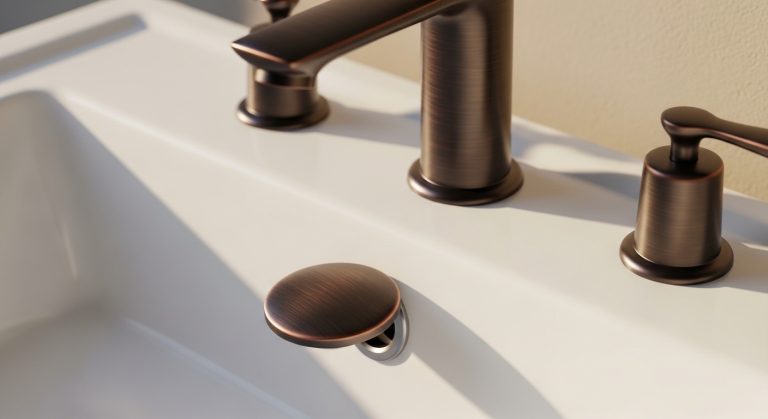
A common real-world snag: you install the bronze tub and shower set, then realize your sink still has a chrome faucet and there’s an unused hole on the vanity. Two quick fixes — swap the sink faucet to a matching ORB one (you can find local options in our guide to finding an oil rubbed bronze bathroom faucet nearby that actually lasts), and cover any leftover deck hole with a matching oil rubbed bronze faucet hole cover so the whole vanity reads as one intentional finish.
One caution: not all “bronze” is the same tone. Oil rubbed bronze skews dark brown-black with copper undertones, while “bronze” or “Venetian bronze” from another brand may lean lighter or grayer. If you’re mixing manufacturers, buy from the same brand family where you can, or at least compare in person, because two ORB finishes from different makers rarely match exactly.
Can I install an oil rubbed bronze tub and shower set myself?
You can install the trim (spout, shower head, handle) yourself in an afternoon with basic tools — but swapping the rough-in valve means opening the wall and soldering or push-fitting supply lines, which is where most people call a plumber. The good news: if you’re only updating the look and your existing valve brand matches your new trim, you may not need to touch the wall at all.
Here’s a realistic breakdown of a trim-only refresh:
- Shut off water to the shower (or the whole house if there’s no local valve).
- Unscrew the old tub spout — most either twist off or release with a hex set-screw underneath.
- Wrap the spout nipple with plumber’s tape and thread on the new bronze spout, or slide-and-set-screw for slip-fit models.
- Unscrew the old shower head, tape the shower arm threads, and hand-tighten the new head (plus a light wrench-nudge).
- Pop off the old handle and escutcheon, then mount the new trim plate and handle to your existing valve stem.
- Turn water back on and check for leaks at the spout diverter and behind the handle.
If your valve is old, corroded, or a different brand than your new trim, that’s the point to bring in a pro — a mismatched cartridge is the usual reason a “simple” swap turns into a wall-opening project. Before you buy, confirm your existing rough-in brand and whether the set is trim-only or a full valve-included kit.
Which brands make a bronze tub and shower set that lasts?
The most reliable oil rubbed bronze tub and shower sets come from brands that use solid brass bodies, ceramic-disc cartridges, and back the finish with a real warranty — Afinion Home, plus the usual established names in the category. Rather than chase the cheapest listing, match the brand to your valve situation and your budget tier. We compare the leading options in our roundup of the best bathtub faucet brands to buy in 2026, which is the natural next read if you’re still shortlisting.
Whatever brand you land on, run this quick checklist before checkout:
- Body material: solid brass, not zinc or “metal alloy” only.
- Finish type: genuine living ORB or PVD bronze — not “bronze finish” over paint.
- Valve: pressure-balance or thermostatic with a ceramic-disc cartridge.
- Certification: look for cUPC/NSF listing and lead-free (NSF/ANSI 372) compliance.
- Warranty: lifetime finish-and-function is the gold standard for this category.
- Included parts: confirm whether the rough-in valve is in the box.
FAQ
Is oil rubbed bronze out of style in 2026?
No. Oil rubbed bronze remains a strong choice for warm, transitional, farmhouse, and traditional bathrooms, and its ability to hide water spots keeps it practical regardless of trends. Matte black and brushed gold get more headlines right now, but ORB is a classic finish that has stayed in continuous demand for over two decades — it reads as timeless rather than trendy.
What’s the difference between oil rubbed bronze and matte black for a shower set?
Oil rubbed bronze is a warm dark brown-black with copper undertones and is usually a “living” finish that lightens on high-touch spots over time. Matte black is a cooler, flatter, uniform black that stays consistent and pairs with modern décor. Choose ORB for warm, traditional palettes and matte black for cool, contemporary ones; both hide water spots far better than chrome.
Do I need to buy the rough-in valve separately?
Sometimes. Many sets are sold as “trim only,” meaning you reuse your existing in-wall valve, while others include the rough-in valve. Always read the listing: if you’re doing new construction or a full remodel you need the valve included, but if you’re just updating the look and your existing valve brand matches the new trim, trim-only is cheaper and easier.
How do I clean an oil rubbed bronze tub and shower faucet without ruining it?
Wipe it with a soft damp cloth and mild soap, then dry it — that’s it for daily care. Never use abrasive pads, ammonia, or acidic cleaners on a living ORB finish, because they can strip the dark coating unevenly. For stubborn hard-water crust, a cloth dampened with diluted white vinegar held on the spot works, but rinse and dry afterward.
Will a bronze shower head reduce my water pressure?
The finish has nothing to do with pressure — flow rate does. All U.S. shower heads are capped at 2.5 GPM (lower in some states), so a bronze head performs the same as a chrome one at the same rating. If your pressure feels weak, the culprit is usually a clogged head, a partially closed valve, or low household pressure, not the bronze finish.
Can I mix an oil rubbed bronze shower set with a different-brand valve?
Only if the trim is specifically listed as compatible with your valve’s rough-in body. Trim kits are engineered around a particular cartridge and spline, so a random brand pairing often won’t seat, won’t seal, or won’t reach the correct depth. When in doubt, buy the trim and valve from the same brand family, or confirm cross-compatibility in the spec sheet before ordering.
The bottom line
An oil rubbed bronze tub and shower faucet set is genuinely worth it in 2026 for warm, traditional, and transitional bathrooms — provided you buy a real set: solid brass body, ceramic-disc pressure-balance (or thermostatic) valve, and a true living or PVD bronze finish, not a spray-painted fake. Budget $130–$250 for a set that lasts, confirm whether the rough-in valve is included, and keep all your visible metal in the same bronze family for a cohesive room. Do that, and you’ll get a spot-hiding, low-maintenance shower that looks better in five years than the day you installed it.
About the author & Afinion Home: This guide was written by the Afinion Home fixtures team, which specializes exclusively in faucets, shower systems, and bathroom fixtures. Our recommendations are based on hands-on testing of tub-and-shower trim and valve assemblies, and we prioritize sets that meet cUPC/NSF certification, NSF/ANSI 372 lead-free standards, and carry a manufacturer finish-and-function warranty. We only recommend fixtures we’d install in our own homes.